Dr. Utz Herbig received his master???s degree in chemistry/biochemistry from Ludwig-
Maximilians-Universit??t in Munich, Germany. Subsequently, he moved to the United
States and attended graduate school at Vanderbilt University, where he received his
PhD in 1999 on the mechanisms of eukaryotic DNA replication initiation. From 2000-
2006, he conducted postdoctoral work at Brown University in the laboratory of Dr.
John Sedivy. Working on replicative senescence, a stable proliferative arrest
encountered by all somatic human cells after repeated rounds of cell division, he
discovered that cells undergo senescence due to telomere dysfunction. After
developing techniques to reliably identify senescent cells with dysfunctional telomeres
in tissues, he could demonstrate that senescent cells increase in abundance in some
tissues of aging primates, suggesting a potential pro-aging role for telomere-initiated
senescence in long-lived mammals.
After joining the Cancer Center of the New Jersey Medical School-Rutgers in 2006, Dr.
Herbig established an independent research program to work on the causes and
biological consequences of telomere dysfunction and cellular senescence in humans.
Among other novel discoveries, he reported a critical role for telomere dysfunction-
induced senescence in suppressing malignant cancer progression, found that
telomere dysfunction can serve as a signal to promote fibroblast-to-myofibroblast
transdifferentiation during tissue repair, and worked on characterizing the
contributions of senescent immune cells to human aging and cancer development. He
sees strong promise that his research will lead to novel strategies to improve cancer
therapies, treat various age-associated disorders, and advance regenerative medicine.
Education
PHD, 1999, Vanderbilt University M.S., 1995, Ludwig-Maximilians-Universitat B.S., 1991, Ludwig-Maximilians-Universitat
Areas Of Interest
Course List
Telomeres and Cellular Senescence in Cancer, Tissue Repair, and Aging
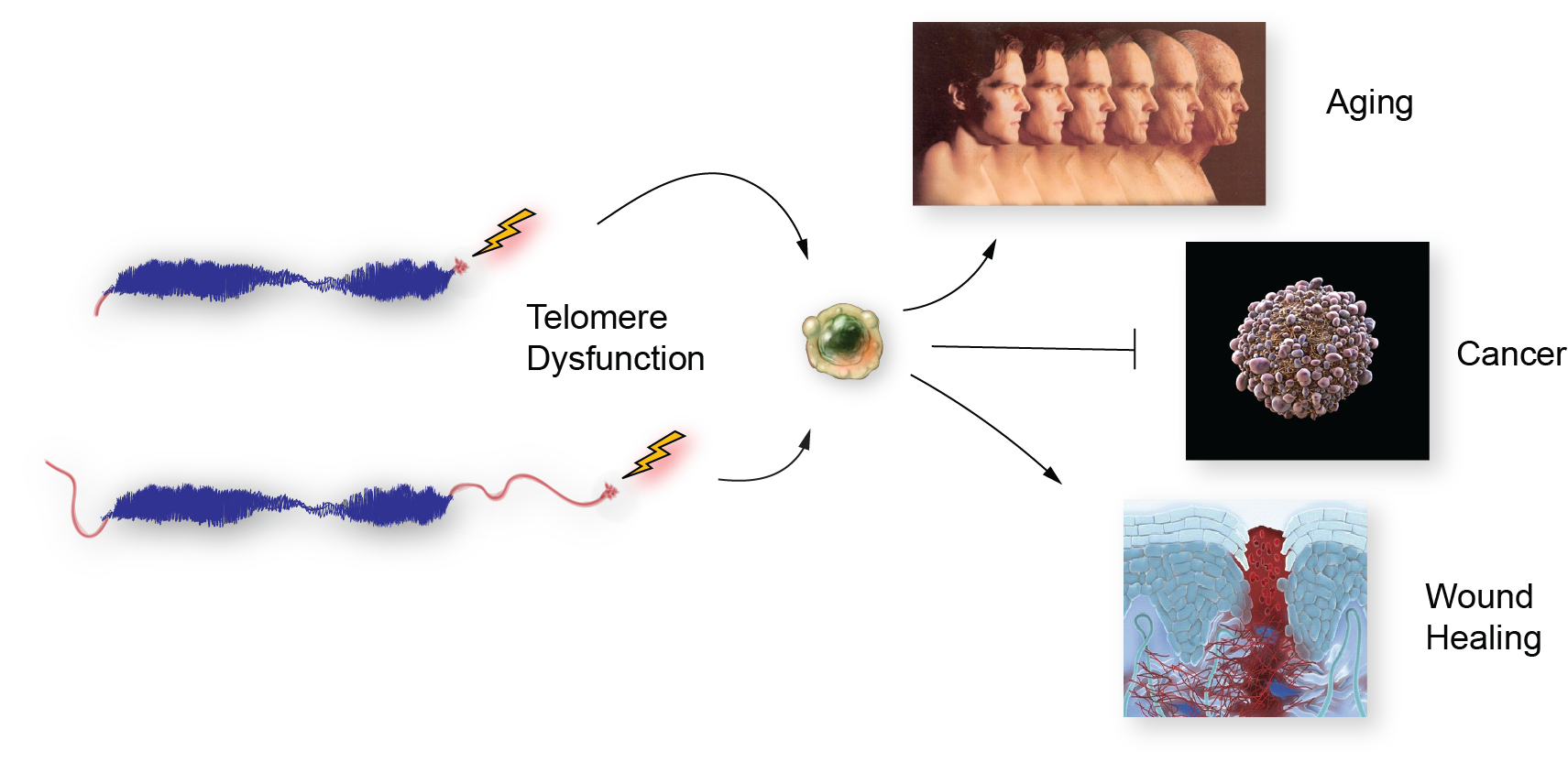
Over 60 years ago, it was reported that somatic human cells cannot proliferate indefinitely and instead undergo stable proliferative arrest, called replicative senescence, after dividing a finite number of times. It was suggested that this limited proliferative capacity served one important purpose: to limit the growth of cancer cells. As a side effect of these tumor-suppressing properties, however, cellular senescence was also predicted to promote aging, as an inability to proliferate extensively would increasingly prevent our cells from regenerating and repairing tissue as we get older. Both predictions, however, remained untested for decades, as the molecular trigger of replicative senescence remained unknown. While my previous work identified dysfunctional telomeres as the molecular switch that activated replicative senescence, work in my current laboratory has provided evidence that telomere dysfunction-induced senescence (TDIS) contributes to the aging of primates, revealed that TDIS acts as a tumor-suppressing mechanism by restricting the proliferation of pre-malignant cancer cells, and demonstrated a role for telomere dysfunction in wound healing and tissue repair.
My research program now focuses on four major areas: 1) causes of telomere shortening and dysfunction, 2) telomeres and cellular senescence in tissue repair and cell plasticity, 3) telomeres and cellular senescence in cancer development, and 4) telomeres and cellular senescence in aging, with a focus on immune cell senescence.